12 Memory management
The kernel of chapter 11, Interrupts, can react to the world, but it
has no idea what the world is made of. It runs at 0x10000
because the bootloader put it there, its stack grows down from
0x90000 because code/README.md says so, and
every pointer it uses is a physical address that we chose by hand. It
does not know how much memory the machine has, it has no way of handing
a piece of that memory to anyone, and nothing stops a stray write from
landing on the IDT. This chapter adds the three pieces that every kernel
has and that chapter 13, Processes, cannot do without: a map of the
physical memory, obtained from the BIOS; an allocator that hands out
that memory in 4 KiB frames; and paging, the mechanism
of the x86 that puts a translation layer between the addresses a program
uses and the addresses the memory bus sees. On top of the frames we
build a small kmalloc, and with paging on, the kernel meets
its first page fault and reports it instead of rebooting.
Before the code, the concepts, which the first edition introduced and
which we keep here.
Running this chapter’s code
The code is in code/chapter12/os: the chapter 11 kernel
plus the four modules and the bootloader step described below. From the
root of the repository, in the chapter 0 container:
$ docker run --rm --user "$(id -u):$(id -g)" --security-opt seccomp=unconfined -v "$PWD":/work -w /work/code/chapter12/os os01 make testmake builds the kernel, the bootloader and
build/disk.img. make qemu and
make gdb, in two terminals, are the pair of chapter 11:
QEMU stopped at its first instruction with the serial port on the
terminal and a gdb stub on port 26000, and gdb connected to it with a
breakpoint at kmain. Every debugger session of this chapter
starts from there; b paging_init, c and
finish stop just after paging is turned on.
make test runs tools/serial-test.sh and waits
for the string Page fault at 0xdeadbeef: the kernel of this
chapter ends, on purpose, with a page fault, and the test checks that
the fault is reported on the serial port instead of rebooting the
machine.
12.1 Address space and virtual memory
An address space is the set of all addressable memory
locations. In a PC there are two of them: the memory address space, 4
GiB wide on a 32-bit CPU, reached by every mov with a
memory operand, and the I/O address space, 64 KiB wide, reached only by
in and out, which chapter 10, Talking to
devices: the serial port and the VGA text console, used for the serial
port. This chapter is about the first one.
Physical memory is a contiguous set of memory locations with a simple mapping between a physical address and the corresponding location in a memory chip, decoded by the memory controller. Virtual memory, on the other hand, does not have a direct mapping between an address and a physical location, even though it appears contiguous from the point of view of a program. Instead, a virtual address is translated, by hardware configured by the OS, into an actual physical address. For that reason, two addresses that are next to each other in virtual memory may be scattered anywhere in physical memory, and each process can have its own address space to do what it wants with, as long as the physical memory is not exhausted.
Why is virtual memory needed? Because it reduces the complexity of
programming, by giving each program the illusion that it has its own
separate “physical” memory to work with. Without virtual memory,
programs must know about each other and agree on their memory regions so
as not to destroy each other. Picture two programs, both linked, as
gcc links every program, to start at the same address, and
both wanting to keep a variable at 0x1000:
| program A | program B | |
|---|---|---|
| virtual address of the variable | 0x1000 |
0x1000 |
| without virtual memory | physical 0x1000 |
physical 0x1000, the same bytes: the last to write
wins |
| with virtual memory | physical 0x1000 maps to frame
0x205000 |
physical 0x1000 maps to frame
0x3a7000 |
Without translation the two programs cannot run at the same time, and
the only way out is to relink one of them for a different address, which
is what MS-DOS programs and the relocation records of chapter 8, Linking
and loading on bare metal, used to do. With translation, each program
keeps its 0x1000, the OS points each one to a different
frame, and neither can even name the other’s memory.
Virtual memory also enables a more secure OS: application programs cannot manipulate main memory directly, so a malicious or buggy program cannot wreck the kernel, another program or a device’s memory-mapped registers, because the only physical memory it can reach is what the OS mapped for it.
Another benefit is that virtual memory can extend beyond physical memory, by storing some of its contents on disk. By swapping out unused memory, for instance the inactive pages of a sleeping process, the system gains free memory to continue running, so no data is destroyed; otherwise the OS would be forced to kill a process to free memory, and you could lose unsaved work. Swapping can slow the whole system down dramatically, because a disk is thousands of times slower than RAM; in the old days, when memory was scarce, it was nevertheless indispensable. Our kernel will not swap, but the page-fault mechanism that makes swapping possible is exactly the one we install at the end of this chapter.
12.2 What this chapter adds
The kernel grows by four modules and the bootloader by one step:
$ diff -rq -x build ../../chapter11/os .
Files ../../chapter11/os/.gdbinit and ./.gdbinit differ
Files ../../chapter11/os/Makefile and ./Makefile differ
Files ../../chapter11/os/bootloader/bootloader.asm and ./bootloader/bootloader.asm differ
Only in ./os: e820.c
Only in ./os: e820.h
Only in ./os: heap.c
Only in ./os: heap.h
Files ../../chapter11/os/os/kernel.c and ./os/kernel.c differ
Files ../../chapter11/os/os/os.lds and ./os/os.lds differ
Only in ./os: paging.c
Only in ./os: paging.h
Only in ./os: pmm.c
Only in ./os: pmm.h
Here is what the finished kernel prints on the serial port, and the rest of the chapter explains it line by line:
$ make test
...output omitted...
serial-test: ok, found "Page fault at 0xdeadbeef"
--- serial output ---
Hello World from the kernel!
CPU: GenuineIntel, QEMU Virtual CPU version 2.5+ (family 6, model 6, stepping 3)
BIOS memory map (8 entries):
  base                 length               type
  0x0000000000000000   0x000000000009fc00   Usable
  0x000000000009fc00   0x0000000000000400   Reserved
  0x00000000000f0000   0x0000000000010000   Reserved
  0x0000000000100000   0x0000000007edf000   Usable
  0x0000000007fdf000   0x0000000000021000   Reserved
  0x00000000b0000000   0x0000000010000000   Reserved
  0x00000000fed1c000   0x0000000000004000   Reserved
  0x00000000fffc0000   0x0000000000040000   Reserved
usable memory: 130555 KiB
frame allocator: 32735 frames below 0x07fdf000, 32479 free (129916 KiB)
paging enabled, page directory at 0x00014000, 32448 frames free
virtual 0x30000000 -> physical 0x0011f000: wrote 0xcafebabe, read back 0xcafebabe, the frame holds 0xcafebabe
kmalloc: a=0xc0000010 b=0xc0000088 c=0xc0000868 (heap 4096 bytes)
after kfree(b), kmalloc(1000) = 0xc0000088 (reuses b's block)
32445 frames free
reading unmapped address 0xdeadbeef...

Page fault at 0xdeadbeef: page not present, read, kernel mode, eip=0x00011069 (error code 0x0)

KERNEL PANIC: unhandled page fault
qemu-system-i386: terminating on signal 15 from pid 238 (/bin/sh)
The driver of it all is kmain, which now reads as a
table of contents:
kernel.c
/* kernel.c -- chapter 12: the kernel manages memory. */
#include <stdint.h>
#include "gdt.h"
#include "idt.h"
#include "isr.h"
#include "pic.h"
#include "pit.h"
#include "keyboard.h"
#include "console.h"
#include "printf.h"
#include "cpuid.h"
#include "e820.h"
#include "pmm.h"
#include "paging.h"
#include "heap.h"

#define TIMER_HZ 100

void kmain(void)
{
    uint32_t frame, cr3;
    volatile uint32_t *window;
    void *a, *b, *c, *d;

    gdt_init();
    console_init();
    idt_init();
    pic_init();
    pit_init(TIMER_HZ);
    keyboard_init();
    asm volatile("sti");

    kprintf("Hello World from the kernel!\n");
    cpuid_print();

    /* 1. What memory is there?  The bootloader asked the BIOS for us. */
    e820_print();
    kprintf("usable memory: %u KiB\n", e820_usable_kib());

    /* 2. Physical frames. */
    pmm_init();
    kprintf("frame allocator: %u frames below %p, %u free (%u KiB)\n",
            pmm_memory_top() / PAGE_SIZE, (void *)pmm_memory_top(),
            pmm_free_frames_count(), pmm_free_frames_count() * 4);

    /* 3. Paging.  Nothing visible changes: the kernel is identity-mapped. */
    paging_init();
    asm volatile("mov %%cr3, %0" : "=r"(cr3));
    kprintf("paging enabled, page directory at %p, %u frames free\n",
            (void *)cr3, pmm_free_frames_count());
The order is, again, the order of dependencies: the memory map is read by the frame allocator, the frame allocator is used by paging to build its tables, and the heap uses both. We take them in that order.
12.3 How much memory is there?
The kernel cannot find out by itself. There is no instruction that
returns the amount of RAM: the memory controller in the chipset knows,
and the only software that talked to the chipset is the firmware. Worse,
physical memory is not one block. The first megabyte of a PC is riddled
with holes inherited from 1981: the VGA frame buffer at
0xA0000, option ROMs, the BIOS ROM at 0xF0000.
Above it, the chipset carves out ranges for the ACPI tables, for
memory-mapped PCI devices, for its own registers, and the firmware keeps
a few pages for itself at the top of RAM. Writing into one of those
ranges because “it is below the RAM size” overwrites a table the kernel
needs later, or talks to a device. The one piece of software that knows
the whole picture is the BIOS, and it is willing to tell.
12.3.1 The BIOS E820 service
The service is INT 15h with EAX = E820h,
and its specification is not in the Intel manual but in the ACPI
specification, chapter 15 “System Address Map Interfaces”, section 15.1
“INT 15H, E820H, Query System Address Map”, with the layout of one entry
in the table “Address Range Descriptor Structure” and the meaning of its
type field in “Address Range Types”. The OSDev wiki page “Detecting
Memory (x86)” is a practical summary with the quirks of real BIOSes. The
service returns the map one entry at a time: each call fills a
buffer that the caller provides, and returns a continuation
value that the caller passes back to get the next entry. An entry
is 20 bytes, or 24 since ACPI 3.0:
| offset | size | field |
|---|---|---|
| 0 | 8 | base address of the range |
| 8 | 8 | length in bytes |
| 16 | 4 | type: 1 usable RAM, 2 reserved, 3 ACPI reclaimable, 4 ACPI NVS, 5 bad RAM |
| 20 | 4 | extended attributes (ACPI 3.0): bit 0 clear means “ignore this entry” |
Base and length are 64 bits, because a PC may have more than 4 GiB of
RAM even when its CPU is running 32-bit code, and because the firmware
maps its flash just under 4 GiB. The register protocol, from the
specification: on input EAX = E820h,
EDX = the ASCII signature 'SMAP'
(0x534D4150), ECX = the size of the buffer,
ES:DI = its address, EBX = the continuation
value, 0 on the first call. On output EAX =
'SMAP' again (if it does not, the BIOS does not support the
service), ECX = the number of bytes written,
EBX = the next continuation value, and CF set
means an error, which some BIOSes use to mean “no more entries”.
EBX = 0 after a call means that this was the last
entry.
The catch is in the first word of the service’s name:
INT 15h is a BIOS call, and the BIOS is 16-bit real-mode
code. Once the bootloader has switched to protected mode, there is no
BIOS any more: the interrupt vector table at address 0 is replaced by
our IDT, and the BIOS code would not run in a 32-bit segment anyway. So
the map has to be collected by the bootloader, before the
switch, and left somewhere for the kernel to find. That somewhere is the
boot information block at physical address 0x500,
listed in code/README.md: the first 1 KiB of memory is the
real-mode IVT and the BIOS data area, the block starts right after it,
and it ends well below the bootloader’s stack at
0x7C00.
12.3.2 The bootloader loop
The step is inserted between reading the kernel and enabling A20, as step 3, and uses these constants:
bootloader/bootloader.asm
; Boot information block (code/README.md, "Memory map"), read by the kernel
; in e820.c.  The layout must match struct bootinfo there.
BOOTINFO        equ 0x500
E820_COUNT      equ BOOTINFO + 0    ; uint32_t: number of entries stored
E820_ENTRIES    equ BOOTINFO + 8    ; 24-byte entries, one after the other
E820_MAX        equ 32              ; the block ends well before our stack
E820_ENTRY_SIZE equ 24
SMAP            equ 0x534d4150      ; 'SMAP' signature, see below
The count is a 32-bit word at 0x500, and the entries
start at 0x508, not 0x504, so that the 64-bit
fields inside them are 8-byte aligned; 32 entries of 24 bytes end at
0x808. Then the loop:
;------------------------------------------------------------------------------
; 3. Memory map.
;    INT 15h, EAX=E820h returns the physical memory map one entry at a
;    time: each call fills the 24-byte buffer at ES:DI with (base, length,
;    type, extended attributes), EAX must hold E820h, EDX the signature
;    'SMAP', ECX the buffer size, and EBX the "continuation value" that the
;    previous call returned (0 for the first call).  The BIOS returns the
;    signature in EAX, the number of bytes written in ECX, the next
;    continuation value in EBX; EBX = 0 or CF = 1 means the last entry
;    (ACPI specification, section 15.1 "INT 15H, E820H - Query System
;    Address Map"; OSDev wiki: "Detecting Memory (x86)").  This has to
;    happen in real mode: there is no BIOS in protected mode.
;    The entries are stored one after the other from E820_ENTRIES and the
;    count at E820_COUNT; ES is 0 so ES:DI is a physical address.
;------------------------------------------------------------------------------
    mov     dword [E820_COUNT], 0
    xor     ebx, ebx
    mov     di, E820_ENTRIES
.e820_next:
    mov     eax, 0xe820
    mov     ecx, E820_ENTRY_SIZE
    mov     edx, SMAP
    ; ACPI 3.0 extended attributes: bit 0 clear means "ignore this entry".
    ; Older BIOSes only write 20 bytes, so preset bit 0 ourselves.
    mov     dword [di + 20], 1
    int     0x15
    jc      .e820_done          ; CF = 1: end of the list (or unsupported)
    cmp     eax, SMAP
    jne     .e820_done          ; no signature: the call is not supported
    inc     dword [E820_COUNT]
    add     di, E820_ENTRY_SIZE
    test    ebx, ebx
    jz      .e820_done          ; EBX = 0: that was the last entry
    cmp     di, E820_ENTRIES + E820_MAX * E820_ENTRY_SIZE
    jb      .e820_next          ; stop before overflowing the block
.e820_done:
Line by line. The count is zeroed and EBX, the
continuation value, with it; DI points at the first entry
slot, and since step 1 set ES to 0, ES:DI is
the physical address 0x508. Each iteration reloads
EAX, ECX and EDX, because the
BIOS overwrites all three: EAX with the signature,
ECX with the byte count, and EDX with, on some
BIOSes, anything at all. Then the line that the comment flags: before
the call, the loop writes a 1 into the extended-attributes
field of the entry it is about to receive. A BIOS that knows ACPI 3.0
overwrites it with the real attributes; an older one writes only 20
bytes and leaves our 1 in place, and since bit 0 set means
“this entry is valid”, the kernel can treat every entry the same way
whatever the BIOS did. Without the preset, a 20-byte BIOS would leave
whatever was at 0x51C before, and a zero there would make
the kernel ignore a perfectly good entry.
After int 0x15, three ways out. CF set is
the end of the list on BIOSes that signal it that way, and also what a
BIOS without the service returns, so the count stays 0 and the kernel
will see an empty map rather than garbage. A wrong signature in
EAX means the same. Otherwise the entry is valid: the count
goes up, DI moves to the next slot, and EBX =
0 says the BIOS has no more. The last comparison stops the loop at 32
entries even if the BIOS has more; real machines return between 10 and
30, so the limit is comfortable, and the alternative is overwriting the
bootloader’s stack.
The loop assembles to 72 bytes, from offset 0x4C to
0x94 in the sector, as nasm -l shows (the
listing columns are line number, offset, bytes, source):
$ nasm -f elf -F dwarf -g -DKERNEL_SECTORS=129 -l bootloader.lst bootloader.asm -o /dev/null
$ sed -n '106,126p' bootloader.lst
   106 0000004C 66C706000500000000          mov     dword [E820_COUNT], 0
   107 00000055 6631DB                      xor     ebx, ebx
   108 00000058 BF0805                      mov     di, E820_ENTRIES
   109                                  .e820_next:
   110 0000005B 66B820E80000                mov     eax, 0xe820
   111 00000061 66B918000000                mov     ecx, E820_ENTRY_SIZE
   112 00000067 66BA50414D53                mov     edx, SMAP
   113                                      ; ACPI 3.0 extended attributes: bit 0 clear means "ignore this entry".
   114                                      ; Older BIOSes only write 20 bytes, so preset bit 0 ourselves.
   115 0000006D 66C7451401000000            mov     dword [di + 20], 1
   116 00000075 CD15                        int     0x15
   117 00000077 721B                        jc      .e820_done          ; CF = 1: end of the list (or unsupported)
   118 00000079 663D50414D53                cmp     eax, SMAP
   119 0000007F 7513                        jne     .e820_done          ; no signature: the call is not supported
   120 00000081 66FF060005                  inc     dword [E820_COUNT]
   121 00000086 83C718                      add     di, E820_ENTRY_SIZE
   122 00000089 6685DB                      test    ebx, ebx
   123 0000008C 7406                        jz      .e820_done          ; EBX = 0: that was the last entry
   124 0000008E 81FF0808                    cmp     di, E820_ENTRIES + E820_MAX * E820_ENTRY_SIZE
   125 00000092 72C7                        jb      .e820_next          ; stop before overflowing the block
   126                                  .e820_done:
Every instruction that touches a 32-bit register starts with the byte
66, the operand-size prefix of chapter 4, x86
Assembly and C: in 16-bit code, mov eax, 0xe820 is
mov ax, ... with a prefix that widens it. SMAP
appears as 50 41 4D 53 in the bytes, 'PAMS'
read forwards, because the little-endian value 0x534D4150
is 'SMAP' when read as the register’s bytes from most to
least significant; that is why the ACPI specification spells the
signature as the letters and the code as a number. The padding line of
the sector tells how much room is left:
$ sed -n '225p' bootloader.lst
   225 00000106 00<rep F8h>             times 510 - ($ - $$) db 0
The code and data end at offset 0x106, 262 bytes, and
248 zero bytes fill the sector up to the signature. Half the sector is
still free: the bootloader is finished as far as this book is concerned,
and the room is yours for the exercises.
12.3.3 The kernel’s view of the map
On the C side, the block is a structure at a fixed address:
e820.h
#ifndef E820_H
#define E820_H

#include <stdint.h>

/* The boot information block the bootloader fills at physical 0x500
   (code/README.md, "Memory map"; bootloader.asm, step 3).  The entry
   layout is the one INT 15h E820h returns (ACPI specification, section
   15.1, the table "Address Range Descriptor Structure"). */
#define BOOTINFO_ADDR 0x500
#define E820_MAX      32

struct e820_entry {
    uint64_t base;      /* first byte of the range */
    uint64_t length;    /* size in bytes */
    uint32_t type;      /* E820_USABLE ... */
    uint32_t attrs;     /* ACPI 3.0 extended attributes (bit 0: valid) */
} __attribute__((packed));

struct bootinfo {
    uint32_t e820_count;
    uint32_t reserved;              /* keeps the entries 8-byte aligned */
    struct e820_entry e820[E820_MAX];
} __attribute__((packed));

/* Address range types, ACPI specification, section 15.1, the table
   "Address Range Types". */
#define E820_USABLE     1   /* RAM the OS may use */
#define E820_RESERVED   2   /* in use by the firmware or hardware, hands off */
#define E820_ACPI       3   /* ACPI tables; reusable once they are parsed */
#define E820_NVS        4   /* ACPI non-volatile storage; must be preserved */
#define E820_BAD        5   /* RAM that failed the firmware's tests */

const struct bootinfo *e820_bootinfo(void);
const char *e820_type_name(uint32_t type);
void e820_print(void);

/* Sum of the lengths of all usable entries, in KiB (fits 32 bits up to
   4 TiB; our kprintf has no 64-bit conversion). */
uint32_t e820_usable_kib(void);

/* Highest address + 1 covered by a usable entry, clipped to 4 GiB. */
uint32_t e820_usable_top(void);

#endif
struct e820_entry is the 24-byte descriptor of the table
above, and struct bootinfo is the block, with the
reserved word that accounts for the gap between
0x504 and 0x508. Both are packed,
as every structure that mirrors a layout defined outside the compiler.
The two numbers that the rest of the kernel needs are computed by
walking the entries of type 1:
e820.c
uint32_t e820_usable_kib(void)
{
    const struct bootinfo *bi = e820_bootinfo();
    uint64_t total = 0;
    uint32_t i;

    for (i = 0; i < bi->e820_count && i < E820_MAX; i++)
        if (bi->e820[i].type == E820_USABLE)
            total += bi->e820[i].length;
    return (uint32_t)(total / 1024);
}

uint32_t e820_usable_top(void)
{
    const struct bootinfo *bi = e820_bootinfo();
    uint64_t top = 0;
    uint32_t i;

    for (i = 0; i < bi->e820_count && i < E820_MAX; i++) {
        const struct e820_entry *e = &bi->e820[i];
        if (e->type == E820_USABLE && e->base + e->length > top)
            top = e->base + e->length;
    }
    if (top > 0xFFFFFFFFULL)
        top = 0xFFFFFFFFULL;
    return (uint32_t)top;
}e820_print, not shown, prints the table we saw; the
64-bit fields go through a small print_u64 because
kprintf only knows 32-bit conversions, which is also why
the totals are returned in KiB. The arithmetic is done in
uint64_t on purpose: on a machine with 8 GiB, the sum of
the lengths does not fit in 32 bits, and e820_usable_top
clips the result to what a 32-bit kernel can address at all.
Before the kernel has printed anything, the block can be read with
gdb at the kmain breakpoint of .gdbinit, as
raw memory and as the structure:
(gdb) x/2xw 0x500
0x500:  0x00000008  0x00000000
(gdb) x/8xg 0x508
0x508:  0x0000000000000000  0x000000000009fc00
0x518:  0x0000000100000001  0x000000000009fc00
0x528:  0x0000000000000400  0x0000000100000002
0x538:  0x00000000000f0000  0x0000000000010000
(gdb) p/x ((struct bootinfo *)0x500)->e820[3]
$2 = {base = 0x100000, length = 0x7edf000, type = 0x1, attrs = 0x1}
(gdb) p sizeof(struct e820_entry)
$3 = 24
Eight entries, and the first three in giant words: base 0, length
0x9fc00, then the 64-bit word
0x0000000100000001, which is type = 1 in its
low half and attrs = 1 in its high half, that is, usable
RAM and the valid bit. The next entry starts at 0x520 with
base 0x9fc00, length 0x400, type 2. The
entries are 24 bytes, so they do not line up with the 16-byte rows of
x/8xg; p on the structure is easier to
read.
12.3.4 QEMU’s map, entry by entry
The eight lines that the kernel printed are the physical address
space of QEMU’s q35 machine with the default 128 MiB of
RAM. Each one has a reason:
0x0to0x9fc00, usable: the first 639 KiB, the conventional memory of the PC. Our bootloader, the boot information block, the kernel at0x10000and its stack at0x90000all live here.0x9fc00to0xa0000, reserved, 1 KiB: the Extended BIOS Data Area, where the BIOS keeps its own variables; the 639 KiB figure instead of 640 is this entry.0xf0000to0x100000, reserved: the BIOS ROM itself, the 64 KiB of SeaBIOS code thatINT 13handINT 15hjumped into. Note what is not listed: from0xa0000to0xf0000there is no entry at all. The VGA memory at0xb8000and the option ROMs are a hole in the map, neither usable nor reserved; a kernel must treat absence as “not RAM”.0x100000to0x7fdf000, usable: extended memory, everything from 1 MiB up, 129916 KiB.0x7fdf000to0x8000000, reserved, 132 KiB: the top of the 128 MiB. The firmware keeps the last pages of RAM for the ACPI tables, the SMBIOS tables and its own data, and marks them reserved so that we do not overwrite them before reading them. This is why the usable memory tops out at0x7fdf000and not at0x8000000, and why the numbers below are 32735 frames and not 32768.0xb0000000to0xc0000000, reserved, 256 MiB: the PCI Express memory-mapped configuration space, MMCONFIG, where every PCIe device’s configuration registers appear in memory, 4 KiB per function; q35 places it there, and the ACPI MCFG table tells the OS. There is no RAM behind this address; a write goes to a device.0xfed1c000to0xfed20000, reserved, 16 KiB: the chipset’s own register block, the Root Complex Base Address of the ICH9 that q35 emulates.0xfffc0000to0x100000000, reserved, 256 KiB: the firmware flash, mapped just below 4 GiB, which is where the CPU fetched its very first instruction after reset (0xfffffff0, the0x0000fff0 in ?? ()that gdb reports when QEMU starts).
The usable total, 639 + 129916 = 130555 KiB, is the first number the
kernel prints. A real machine prints a longer list: more reserved
pockets below 1 MiB, an ACPI reclaimable range and an ACPI NVS range
near the top of RAM, a hole below 4 GiB for the PCI devices, and, with
more than about 3 GiB of RAM, a usable range above
0x100000000 that our 32-bit kernel cannot reach without the
extensions that the epilogue describes.
12.4 Physical frames
Paging, which comes next, works in units of 4 KiB called pages on the virtual side and page frames on the physical side, and every memory structure the kernel builds from now on (page tables, task stacks, heap pages) is a whole number of frames. So the first allocator is a frame allocator: give me a free 4 KiB frame, take this frame back. There are 32735 frames in our 128 MiB, and the simplest data structure that remembers which ones are free is a bitmap, one bit per frame: 32735 bits are 4 KiB, a single page.
pmm.h
#ifndef PMM_H
#define PMM_H

#include <stdint.h>

/* Physical memory manager: hands out 4 KiB frames of RAM.
 *
 * Memory is divided into page frames of PAGE_SIZE bytes, the unit that
 * paging works with (Intel SDM Vol. 3A, section 5.3 "32-bit Paging").  A
 * bitmap holds one bit per frame: 1 = in use, 0 = free.  The frames are
 * numbered from physical address 0, so frame n starts at n * PAGE_SIZE. */
#define PAGE_SIZE   4096
#define PAGE_SHIFT  12

/* The allocator only manages the first PMM_MAX_MEMORY bytes, however
   much RAM the machine has; keeping the bitmap small and static. */
#define PMM_MAX_MEMORY (128u * 1024 * 1024)

void pmm_init(void);

/* Returns the physical address of a free frame and marks it used, or 0 if
   no frame is left.  Frame 0 is never free (it holds the real-mode
   interrupt vectors and the boot information block), so 0 is a safe
   "nothing" value.  The frame's contents are whatever was there before. */
uint32_t pmm_alloc_frame(void);
void     pmm_free_frame(uint32_t phys);
uint32_t pmm_free_frames_count(void);

/* First address after the last frame the allocator manages. */
uint32_t pmm_memory_top(void);

#endif
The interface is three functions and a convention: a frame is named
by its physical address, and 0 means failure, which is safe because
frame 0 holds the IVT and the boot information block and is never handed
out. PMM_MAX_MEMORY caps what the allocator manages at 128
MiB, whatever the machine has, so that the bitmap can be a static array;
a kernel for real machines would size it from the map instead, and that
is exercise 12.3.
pmm.c
#define FRAMES_MAX (PMM_MAX_MEMORY / PAGE_SIZE)     /* 32768 frames */
#define BITS_PER_WORD 32

static uint32_t bitmap[FRAMES_MAX / BITS_PER_WORD];  /* 4 KiB */
static uint32_t frames_total;                       /* frames we manage */
static uint32_t frames_free;

extern char __kernel_start[], __kernel_end[];       /* os.lds */
The two extern char arrays are not arrays: they are
linker symbols, and the kernel uses their addresses, never
their contents. They come from two new lines in the linker script:
os.lds
  /* __kernel_start/__kernel_end tell the frame allocator (pmm.c) which
     frames the kernel image occupies, headers included. */
  __kernel_start = 0x10000;
  .text 0x10100 : ALIGN(0x100) { *(.text .text.*) } :code
  .rodata : { *(.rodata .rodata.*) } :code
  .data   : { *(.data .data.*) } :code
  /* __bss_start/__bss_end let entry.asm zero .bss: the bootloader copies
     the FILE, and .bss has no bytes in the file (NOBITS), so the memory it
     occupies holds whatever followed .data in the file (debug sections)
     until the kernel clears it.  A real ELF loader zeroes MemSiz - FileSiz
     for us; ours does not. */
  .bss    : { __bss_start = .; *(.bss .bss.*) *(COMMON) __bss_end = .; } :code
  __kernel_end = .;
__kernel_start is the address where the bootloader put
the ELF file, headers included, and __kernel_end is the
location counter after .bss, the first byte the kernel does
not own. The extern char name[] declaration is the idiom
for using a linker symbol from C, the same one entry.asm
relied on for __bss_start in chapter 9, Protected mode and
x86 descriptors: the symbol has an address and no size, and an array of
unknown bound is the C type that says exactly that.
Initialization is a subtraction: everything is used, then the usable ranges of the map become free, then what is already occupied becomes used again:
void pmm_init(void)
{
    const struct bootinfo *bi = e820_bootinfo();
    uint32_t top = e820_usable_top();
    uint32_t i;

    if (top > PMM_MAX_MEMORY)
        top = PMM_MAX_MEMORY;
    frames_total = top / PAGE_SIZE;
    frames_free  = 0;
    memset(bitmap, 0xFF, sizeof(bitmap));           /* all used */

    /* 1. RAM reported by the BIOS becomes free... */
    for (i = 0; i < bi->e820_count && i < E820_MAX; i++)
        if (bi->e820[i].type == E820_USABLE)
            mark_range(bi->e820[i].base,
                       bi->e820[i].base + bi->e820[i].length, 0);

    /* 2. ...except what is already in use. */
    mark_range(0, 0x100000, 1);                     /* first megabyte */
    mark_range((uint32_t)__kernel_start, (uint32_t)__kernel_end, 1);
}
Starting from “all used” is what makes the holes of the map harmless:
the range from 0xa0000 to 0xf0000 is never
mentioned by the BIOS, so it is never freed, and the frame allocator
will never hand out the VGA buffer. The whole first megabyte is then
taken back wholesale, which covers the bootloader, the boot information
block, the kernel stack and the EBDA in one line; the kernel image,
which in our layout is inside the first megabyte anyway, gets its own
line so that the code stays correct if it is ever linked higher.
mark_range does the rounding and keeps
frames_free honest:
static void mark_range(uint64_t start, uint64_t end, int used)
{
    uint32_t first, last, frame;

    if (end > (uint64_t)frames_total * PAGE_SIZE)
        end = (uint64_t)frames_total * PAGE_SIZE;
    if (start >= end)
        return;
    if (used) {
        first = (uint32_t)(start / PAGE_SIZE);
        last  = (uint32_t)((end + PAGE_SIZE - 1) / PAGE_SIZE);
    } else {
        first = (uint32_t)((start + PAGE_SIZE - 1) / PAGE_SIZE);
        last  = (uint32_t)(end / PAGE_SIZE);
    }
    for (frame = first; frame < last; frame++) {
        if (used && !frame_is_used(frame)) {
            frame_set_used(frame);
            frames_free--;
        } else if (!used && frame_is_used(frame)) {
            frame_set_free(frame);
            frames_free++;
        }
    }
}
The two roundings go in opposite directions, and the comment in the
source says why: a frame that is only partly covered by a reserved range
is reserved (round outwards), a frame that is only partly covered by a
usable range is not usable (round inwards). The first usable entry ends
at 0x9fc00, in the middle of frame 0x9f, so
that frame is not freed; the EBDA is safe even before the
first-megabyte line runs. Allocation is a linear scan for a zero bit,
skipping full words:
uint32_t pmm_alloc_frame(void)
{
    uint32_t word, bit;

    for (word = 0; word < frames_total / BITS_PER_WORD; word++) {
        if (bitmap[word] == 0xFFFFFFFF)
            continue;                               /* all 32 used */
        for (bit = 0; bit < BITS_PER_WORD; bit++) {
            if (!(bitmap[word] & (1u << bit))) {
                uint32_t frame = word * BITS_PER_WORD + bit;
                frame_set_used(frame);
                frames_free--;
                return frame * PAGE_SIZE;
            }
        }
    }
    return 0;
}

void pmm_free_frame(uint32_t phys)
{
    uint32_t frame = phys / PAGE_SIZE;

    if (frame < frames_total && frame_is_used(frame)) {
        frame_set_free(frame);
        frames_free++;
    }
}
It is slow in the worst case, a thousand words to scan when memory is
nearly full, and it always returns the lowest free frame, which is what
makes the addresses in this chapter’s output predictable: the first
frame ever allocated is 0x100000, the first one above the
first megabyte. A faster allocator keeps a free list or a search hint;
the bitmap is enough for us, and the interface would not change.
The numbers the kernel printed now make sense.
frames_total is 0x7fdf000 / 4096 = 32735, the
top of the usable map, and 32479 are free: 32735 minus the 256 frames of
the first megabyte, in which the kernel image already lies. Under gdb,
after finish from pmm_init:
(gdb) p frames_total
$5 = 32735
(gdb) p frames_free
$6 = 32479
(gdb) x/4xw bitmap
0x16020 <bitmap>:   0xffffffff  0xffffffff  0xffffffff  0xffffffff
(gdb) x/2xw &bitmap[7]
0x1603c <bitmap+28>:    0xffffffff  0x00000000
(gdb) p/x bitmap[1022]
$9 = 0x80000000
(gdb) p/x bitmap[1023]
$10 = 0xffffffff
(gdb) p &__kernel_end
$12 = (char (*)[]) 0x17030
Words 0 to 7 are all ones, 256 frames, the first megabyte; word 8
starts the free memory at frame 256, 0x100000. Word 1022
has only its top bit set: frame 32735 is the first one above
frames_total, never freed, and word 1023 is entirely above
the map. The kernel ends at 0x17030, so frame
0x17 is the last one it occupies, and all of it is inside
the first megabyte as promised.
12.5 Paging on x86
The reading guide for this section is Intel SDM Volume 3A, chapter 5 “Paging”. It is long because it describes four paging modes; we use the oldest and simplest, and the sections you need are these:
Section 5.1 “Paging Modes and Control Bits”: paging is enabled by
CR0.PG, bit 31, andCR4.PAEandCR4.PSEselect the mode. With both clear we get 32-bit paging, the mode of the 80386, which is the only one that fits a 32-bit page table entry and the one this chapter uses. Table 5-1 “Properties of Different Paging Modes” compares them: 32-bit paging translates 32-bit linear addresses into 32-bit physical addresses, 4 GiB of each, with 4 KiB or 4 MiB pages.Section 5.2 “Hierarchical Paging Structures: An Overview” explains the idea of a multi-level table, and why: a flat table with one entry per 4 KiB page of a 4 GiB address space would be 4 MiB per address space, mostly empty. Two levels let the empty parts cost nothing.
Section 5.3 “32-Bit Paging” is the one to read with the code open. Figure 5-2 “Linear-Address Translation to a 4-KByte Page using 32-Bit Paging” is the picture to memorize: the 32-bit address is cut into 10, 10 and 12 bits. Table 5-3 gives the format of
CR3, table 5-5 “Format of a 32-Bit Page-Directory Entry that References a Page Table” and table 5-6 “Format of a 32-Bit Page-Table Entry that Maps a 4-KByte Page” the two entry formats, and figure 5-4 draws them side by side. Table 5-4 is the 4 MiB page variant, which we do not use.Section 5.6 “Access Rights”: which accesses are allowed, as a function of the R/W and U/S bits at every level of the walk, and of the privilege level of the access. The rule to retain: the most restrictive entry wins.
Section 5.7 “Page-Fault Exceptions”: when the CPU raises
#PFand what it reports. Figure 5-12 is the error code.Section 5.8 “Accessed and Dirty Flags”: two bits that the CPU sets on its own and that an OS that swaps reads.
Section 5.10 “Caching Translation Information”: the TLB, and section 5.10.4 “Invalidation of TLBs and Paging-Structure Caches”, the part about
invlpgand about writingCR3, which answers the question “I changed a page table entry, why does the CPU not see it?”.
Section 2.5 “Control Registers” of the same volume describes
CR0, CR2 and CR3 themselves.
12.5.1 The translation
With paging on, every address that an instruction produces, the linear address (which, with our flat segments, is the virtual address of the program), goes through this walk before it reaches the bus:
- Bits 31:22 of the address, ten bits, index the page
directory, a 4 KiB array of 1024 32-bit entries whose physical
address is in
CR3. The entry selected, a PDE, holds the physical address of a page table, or a present bit of 0. - Bits 21:12, ten bits, index that page table, another 4 KiB array of 1024 entries. The entry selected, a PTE, holds the physical address of a 4 KiB frame, or a present bit of 0.
- Bits 11:0, twelve bits, are the offset inside that frame and go through unchanged.
The figure below is figure 5-2 of the manual with our names on it; the three dashed arrows are the three indexes, the two solid ones the two addresses read from the tables.
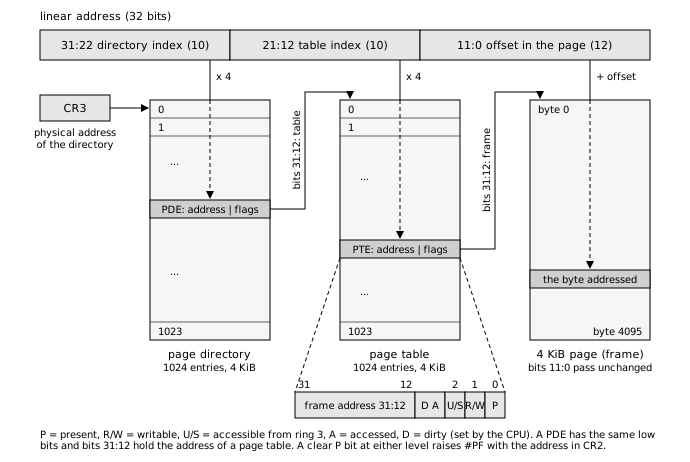
So one page directory covers the whole 4 GiB, one page table covers 4 MiB, and one entry covers 4 KiB. A directory whose entries are all absent costs one page and maps nothing; each 4 MiB region that is used costs one more page for its table. The entry formats of tables 5-5 and 5-6 are nearly identical, which is why one C header serves both:
paging.h
/* 32-bit two-level paging, Intel SDM Vol. 3A, section 5.3 "32-Bit Paging".
 *
 * A linear address is split in three:
 *     bits 31:22  index into the page directory (1024 entries)
 *     bits 21:12  index into the page table that entry points to (1024)
 *     bits 11:0   offset inside the 4 KiB page
 * Directory and tables are 4 KiB arrays of 32-bit entries; the entry holds
 * the physical address of the next level (bits 31:12, so it must be 4 KiB
 * aligned) and flags in the low 12 bits (SDM Vol. 3A, Table 5-5 and 5-6):
 */
#define PAGE_PRESENT   0x001    /* bit 0, P:   the entry is valid */
#define PAGE_WRITE     0x002    /* bit 1, R/W: writes allowed */
#define PAGE_USER      0x004    /* bit 2, U/S: ring 3 may access it */
#define PAGE_ACCESSED  0x020    /* bit 5, A:   set by the CPU on access */
#define PAGE_DIRTY     0x040    /* bit 6, D:   set by the CPU on write (PTE) */
#define PAGE_FRAME     0xFFFFF000   /* bits 31:12: physical address */

#define PAGE_DIR_INDEX(virt)   (((virt) >> 22) & 0x3FF)
#define PAGE_TABLE_INDEX(virt) (((virt) >> 12) & 0x3FF)
#define PAGE_ALIGN_DOWN(a)     ((a) & PAGE_FRAME)
#define PAGE_ALIGN_UP(a)       (((a) + 0xFFF) & PAGE_FRAME)
Because a page table and a frame are both 4 KiB aligned, their physical address has twelve zero low bits, and the entry formats reuse those twelve bits for flags. The ones we use:
| bit | name | meaning |
|---|---|---|
| 0 | P, present | 1: the entry is valid. 0: the other 31 bits are the OS’s to use and
any access raises #PF |
| 1 | R/W | 0: read only (for user accesses, and for the kernel too when
CR0.WP is set); 1: writable |
| 2 | U/S | 0: supervisor, ring 3 may not touch it; 1: user |
| 3, 4 | PWT, PCD | cache policy; 0 for RAM |
| 5 | A, accessed | set by the CPU when the entry is used in a walk |
| 6 | D, dirty | PTE only: set by the CPU on a write through this entry |
| 7 | PS | PDE only: 1 makes it a 4 MiB page; must be 0 for us |
| 31:12 | address | physical address of the page table (PDE) or frame (PTE) |
Three bits, P, R/W and U/S, are the entire protection model of this
book. P is what makes the page fault of the end of this chapter and the
demand paging of real kernels possible. U/S is what will keep chapter
13’s user programs out of the kernel: the kernel’s pages have U/S = 0,
so a ring-3 access to them faults. R/W is what makes a read-only
.text possible (exercise 12.2). CR3 holds the
physical address of the directory in its bits 31:12, with the same
alignment requirement; its low bits are two more cache-policy flags that
stay 0.
Section 5.6 states the combination rule: an access is allowed only if
both the PDE and the PTE allow it. A user access needs U/S = 1
in both; a write needs R/W = 1 in both for a user access, and in both
for a supervisor access as well when CR0.WP is set. For
supervisor accesses with CR0.WP clear, which is our case,
R/W is ignored: the kernel can write to a read-only page. This is a
historical default and every modern kernel sets WP so that
the kernel cannot scribble on its own code by mistake; we leave it clear
in this chapter and exercise 12.2 turns it on.
12.5.2 The kernel’s page directory
paging.c
/* paging.c -- the kernel page directory and the page-fault handler.
 *
 * The kernel keeps "virtual == physical" for all the RAM it manages: the
 * page directory identity-maps every frame of the allocator.  That is the
 * simplest possible scheme and it means C pointers to frames work
 * unchanged after paging is on.  Everything above pmm_memory_top() is free
 * virtual space, used for the kernel heap (heap.c) and, later, for user
 * programs.
 */
#include "paging.h"
#include "pmm.h"
#include "isr.h"
#include "printf.h"
#include "panic.h"
#include "string.h"

/* Both must be 4 KiB aligned: CR3 and the directory entries only store
   bits 31:12 of their address (SDM Vol. 3A, Table 5-3 and 5-5). */
static uint32_t kernel_directory[1024] __attribute__((aligned(PAGE_SIZE)));
static uint32_t kernel_table0[1024]    __attribute__((aligned(PAGE_SIZE)));
The comment at the top states the design decision of the chapter, so
let us state it again in one sentence: every frame that the
allocator manages is mapped at the virtual address equal to its physical
address. This is called an identity map, and its
consequence is the invariant that the rest of the kernel relies on: a
physical address returned by pmm_alloc_frame is a valid
pointer, before paging is on and after. When get_table
below allocates a frame for a page table and writes to it through
(void *)frame, that works because of the identity map; when
chapter 13 allocates a frame for a user stack and copies a program into
it, same thing. The price is that the kernel’s virtual space from 0 to
128 MiB is spoken for, which is why the heap starts at
0xC0000000 and user programs at 0x08048000:
0x00400000 would have been RAM, and mapping the
heap there would hide 4 MiB of frames behind it.
The two static arrays are the directory and the first page table.
They are in .bss with aligned(PAGE_SIZE),
because CR3 and a PDE only store bits 31:12 of the address:
a directory at 0x14010 would be read as a directory at
0x14000. The alignment is visible in the kernel’s layout,
and we come back to it in the build section.
static uint32_t *get_table(uint32_t *dir, uint32_t virt, int create,
                           uint32_t flags)
{
    uint32_t *pde = &dir[PAGE_DIR_INDEX(virt)];

    if (!(*pde & PAGE_PRESENT)) {
        uint32_t frame;

        if (!create)
            return 0;
        frame = pmm_alloc_frame();
        if (frame == 0)
            panic("paging: out of frames for a page table");
        memset((void *)frame, 0, PAGE_SIZE);        /* every entry not present */
        /* The directory entry is as permissive as any page below it may
           need to be; the page table entries do the real restricting
           (SDM Vol. 3A, section 5.6 "Access Rights": both levels must
           allow an access). */
        *pde = frame | PAGE_PRESENT | PAGE_WRITE | (flags & PAGE_USER);
    } else if ((flags & PAGE_USER) && !(*pde & PAGE_USER)) {
        *pde |= PAGE_USER;
    }
    return (uint32_t *)(*pde & PAGE_FRAME);
}
get_table is the first level of the walk, done in
software: take the directory entry for virt, and if it is
not present and the caller wants one, allocate a frame, clear it (a page
table full of garbage would be a page table full of random mappings),
and install it with P and R/W set. The directory entry is made writable
and, when asked, user-accessible, because of the combination rule: the
PDE must allow everything that any PTE under it will allow, and the PTE
does the real restricting. The last line converts the entry back into a
pointer by masking off the flags, and it is, again, the identity map
that makes that pointer usable.
static void invlpg(uint32_t virt)
{
    asm volatile("invlpg (%0)" : : "r"(virt) : "memory");
}

static void map_in(uint32_t *dir, uint32_t virt, uint32_t phys, uint32_t flags)
{
    uint32_t *table = get_table(dir, virt, 1, flags);

    table[PAGE_TABLE_INDEX(virt)] = (phys & PAGE_FRAME) | PAGE_PRESENT
                                  | (flags & (PAGE_WRITE | PAGE_USER));
    invlpg(virt);
}

void paging_map(uint32_t virt, uint32_t phys, uint32_t flags)
{
    map_in(kernel_directory, virt, phys, flags);
}

void paging_unmap(uint32_t virt)
{
    uint32_t *table = get_table(kernel_directory, virt, 0, 0);

    if (table != 0) {
        table[PAGE_TABLE_INDEX(virt)] = 0;
        invlpg(virt);
    }
    /* The page table itself stays, even if empty: cheaper than counting
       its users, and it will probably be needed again. */
}
map_in is the second level: one store into the page
table, frame address plus flags. paging_map is the public
version for the kernel directory; map_in takes the
directory as a parameter because chapter 13 will have one directory per
process. paging_unmap zeroes the entry, and both call
invlpg.
Why invlpg? Because the CPU does not walk the tables on
every access. That would triple the cost of every memory reference, so
it caches the result of recent walks in the Translation Lookaside
Buffer, section 5.10.2, a small associative memory of (virtual
page, physical frame, flags) entries. The tables in memory are the
source of truth, but the CPU only consults them on a TLB miss. When the
kernel changes an entry, a stale translation may stay in the TLB, and
the next access to that page goes to the old frame, or succeeds on a
page that was just unmapped. Section 5.10.4.1 lists the instructions
that invalidate: invlpg m drops the TLB entry for the page
containing the address m, and a mov cr3 drops
them all (except the global ones, a feature we do not use).
invlpg after each change is the precise and cheap option;
reloading CR3 is the sledgehammer that chapter 13 uses when
it switches address spaces. The "memory" clobber on the
asm statement tells gcc that memory may have
changed, so that it does not keep a value loaded through the old mapping
in a register across the call. The instruction itself:
$ objdump -d -M intel build/os/os | grep 'invlpg BYTE'
   11214:   0f 01 38                invlpg BYTE PTR [eax]
12.5.3 Turning paging on
void paging_init(void)
{
    uint32_t addr, top = pmm_memory_top();
    uint32_t cr0;

    /* 1. The first 4 MiB (kernel, stack, VGA, boot information block) use
       a static page table so that nothing depends on the allocator. */
    memset(kernel_directory, 0, sizeof(kernel_directory));
    for (addr = 0; addr < 0x400000; addr += PAGE_SIZE)
        kernel_table0[PAGE_TABLE_INDEX(addr)] = addr | PAGE_PRESENT | PAGE_WRITE;
    kernel_directory[0] = (uint32_t)kernel_table0 | PAGE_PRESENT | PAGE_WRITE;

    /* 2. The rest of the managed RAM gets page tables from the frame
       allocator.  Paging is still off, so the fresh tables can be written
       at their physical address; once it is on, they still can because
       they are identity-mapped like everything else. */
    for (addr = 0x400000; addr < top; addr += PAGE_SIZE)
        paging_map(addr, addr, PAGE_WRITE);

    isr_register_handler(14, page_fault_handler);

    /* 3. CR3 holds the physical address of the page directory (SDM Vol.
       3A, section 2.5 "Control Registers" and Table 5-3); CR0.PG (bit 31)
       turns paging on.  The next instruction fetch is already translated,
       which is fine because the kernel is identity-mapped. */
    asm volatile("mov %0, %%cr3" : : "r"(kernel_directory) : "memory");
    asm volatile("mov %%cr0, %0" : "=r"(cr0));
    cr0 |= 0x80000000;
    asm volatile("mov %0, %%cr0" : : "r"(cr0) : "memory");
}
Step 1 fills the static table with the identity map of the first 4
MiB, 1024 entries of addr | 3, and hooks it into entry 0 of
the directory. Everything the kernel is made of lives in those 4 MiB, so
this is the part that must be right before paging is turned on, and it
uses no allocator so that it cannot fail. Step 2 maps the remaining 124
MiB with paging_map, one page at a time, which creates 31
page tables on the way, from the frame allocator; the comment points out
the subtlety: paging_map writes into those tables through
their physical address, which is correct now because paging is off, and
stays correct afterwards because the tables are identity-mapped too.
Step 3 is the switch, and it is two instructions:
$ objdump -d -M intel build/os/os | sed -n '/<paging_init>:/,/ret/p' | tail -10
   1142d:   b8 00 40 01 00          mov    eax,0x14000
   11432:   0f 22 d8                mov    cr3,eax
   11435:   0f 20 c0                mov    eax,cr0
   11438:   89 45 ec                mov    DWORD PTR [ebp-0x14],eax
   1143b:   81 4d ec 00 00 00 80    or     DWORD PTR [ebp-0x14],0x80000000
   11442:   8b 45 ec                mov    eax,DWORD PTR [ebp-0x14]
   11445:   0f 22 c0                mov    cr0,eax
   11448:   90                      nop
   11449:   c9                      leave
   1144a:   c3                      ret
mov cr3, eax loads the directory’s address,
0x14000, and mov cr0, eax with bit 31 set
turns paging on. The instruction after it, the nop at
0x11448, is already fetched through the page tables: the
CPU translates 0x11448 through PDE 0,
kernel_table0[0x11], and finds frame 0x11000,
the same address. Had that entry been wrong, the fetch would have
faulted, the fault handler’s address in the IDT would have been
translated through the same broken tables, and the result would have
been the triple fault of chapter 11. This is the moment every kernel
author remembers: the first instruction after CR0.PG is set
either works or reboots the machine. The reason it works for us is that
the identity map makes the switch invisible: nothing in the kernel
changes its address, the stack is where it was, ESP still
points at it, and kmain continues at the next line as if
nothing had happened. A kernel that lives at a different
virtual address than its physical one (the usual choice, with the kernel
at 0xC0000000 and above, is called a higher-half
kernel) has to map itself twice around this instruction, at its old
and its new address, and jump from one to the other; we avoid all of
that by design, and pay for it with the 128 MiB of virtual space the
identity map occupies.
What else changes for the kernel once paging is on? Nothing, and that
is the point. Every pointer still works, every kprintf
still writes to 0xB8000, because
kernel_table0[0xB8] maps it to itself. The difference is
that from now on there are addresses that do not work, and the
kernel can make new ones work by calling paging_map.
12.5.4 Looking at the tables
Stop under gdb after paging_init returns
(b paging_init, c, finish) and
ask the CPU:
(gdb) p/x $cr3
$14 = 0x14000
(gdb) p &kernel_directory
$15 = (uint32_t (*)[1024]) 0x14000 <kernel_directory>
(gdb) p &kernel_table0
$16 = (uint32_t (*)[1024]) 0x15000 <kernel_table0>
(gdb) monitor info registers
...output omitted...
GDT=     00013000 00000017
IDT=     00013040 000007ff
CR0=80000011 CR2=00000000 CR3=00014000 CR4=00000000
...output omitted...
Before paging_init, the same command showed
CR0=00000011: PE (bit 0) and ET (bit 4, a leftover that
reads as 1). Now bit 31 is set, CR3 is the directory,
CR4 is 0 (no PAE, no PSE: 32-bit paging). The directory
itself:
(gdb) x/4xw kernel_directory
0x14000 <kernel_directory>: 0x00015023  0x00100003  0x00101003  0x00102003
(gdb) p/x kernel_directory[31]
$19 = 0x11e003
(gdb) p/x kernel_directory[32]
$20 = 0x0
(gdb) p/x kernel_table0[0x10]
$23 = 0x10003
(gdb) p/x kernel_table0[0xb8]
$24 = 0xb8003
(gdb) p/x ((uint32_t *)(kernel_directory[1] & 0xfffff000))[0]
$25 = 0x400003
(gdb) p/x ((uint32_t *)(kernel_directory[31] & 0xfffff000))[0x3de]
$27 = 0x7fde003
(gdb) p/x ((uint32_t *)(kernel_directory[31] & 0xfffff000))[0x3df]
$28 = 0x0
Example 12.1. Decoding the first two entries by hand
against tables 5-5 and 5-6. PDE 0 is 0x00015023: the
address bits 31:12 are 0x00015, so the page table is at
0x15000, which is kernel_table0; the low
twelve bits 0x023 are 0000 0010 0011, bit 0 P
= 1, bit 1 R/W = 1, bit 2 U/S = 0, bit 5 A = 1. The accessed bit was set
by the CPU itself, on the first walk through this entry after paging
came on. PDE 1 is 0x00100003: a page table at
0x100000, the first frame the allocator handed out, P and
R/W set, A clear because nothing in the 4 to 8 MiB region has been
touched. The last directory entry that is present is 31, with the table
at 0x11e000, the 31st frame allocated; entry 32, which
would cover 128 MiB and up, is 0. Inside that last table, entry
0x3de maps 0x7fde000 to itself, and entry
0x3df, the page at 0x7fdf000, is 0: the
firmware’s reserved pages at the top of RAM are not mapped, because they
are not in the frame allocator. In kernel_table0, entry
0x10 is 0x10003, the kernel’s first page
mapped to itself, and entry 0xb8 the VGA buffer.
QEMU’s monitor can walk the tables for us. info mem
lists the mapped virtual ranges, merging contiguous pages with the same
flags, and info tlb lists every page:
(gdb) monitor info mem
0000000000000000-0000000007fdf000 0000000007fdf000 -rw
(gdb) monitor info tlb
0000000000000000: 0000000000000000 --------W
0000000000001000: 0000000000001000 --------W
...output omitted...
0000000000010000: 0000000000010000 --------W
0000000000011000: 0000000000011000 ----A---W
...output omitted...
0000000007fde000: 0000000007fde000 --------W
One range, from 0 to 0x7fdf000, 32735 pages, read-write,
supervisor only (a u would appear in the flags for user
pages). Each line of info tlb is virtual page, physical
frame, flags; despite its name it prints the page tables, not the CPU’s
TLB. The one A in the excerpt is on the page
0x11000, the one that holds the end of
paging_init: the first code fetched through the tables.
(The stack page, 0x8f000, has one too, further down the
list.)
12.5.5 A mapping that is not the identity
Everything above 0x7fdf000 is unmapped virtual space,
and kmain uses it to show the translation at work:
kernel.c
    /* 4. A virtual address far away from any RAM, backed by a real frame.
       Writing through the window and reading the frame directly (it is
       identity-mapped) shows both addresses name the same bytes. */
    frame = pmm_alloc_frame();
    paging_map(0x30000000, frame, PAGE_WRITE);
    window = (volatile uint32_t *)0x30000000;
    *window = 0xCAFEBABE;
    kprintf("virtual %p -> physical %p: wrote 0x%x, read back 0x%x, "
            "the frame holds 0x%x\n", (void *)window, (void *)frame,
            0xCAFEBABE, *window, *(volatile uint32_t *)frame);
    paging_unmap(0x30000000);
    pmm_free_frame(frame);
A frame is allocated, 0x11f000, the next free one after
the 31 page tables. It is mapped at 0x30000000, 768 MiB, an
address at which the machine has no memory at all. The kernel writes
through the window and reads the same value back through the frame’s own
address, which is also mapped, by the identity map. Two virtual
addresses, 0x30000000 and 0x0011f000, name the
same four bytes of RAM:
virtual 0x30000000 -> physical 0x0011f000: wrote 0xcafebabe, read back 0xcafebabe, the frame holds 0xcafebabeUnder gdb, with a conditional breakpoint
(b paging_map if virt == 0x30000000) and
finish:
(gdb) p/x kernel_directory[0x30000000 >> 22]
$31 = 0x120003
(gdb) p/x ((uint32_t *)(kernel_directory[0xc0] & 0xfffff000))[0]
$32 = 0x11f003
(gdb) monitor info mem
0000000000000000-0000000007fdf000 0000000007fdf000 -rw
0000000030000000-0000000030001000 0000000000001000 -rw
0x30000000 >> 22 is 0xc0, 192:
directory entry 192 was empty, so get_table allocated a
frame for a new page table, 0x120000, and entry 0 of that
table (bits 21:12 of 0x30000000 are 0) now holds frame
0x11f000 with P and R/W. info mem shows the
second range. After paging_unmap and
pmm_free_frame, the frame is free again but the page table
at 0x120000 stays allocated, as the comment in
paging_unmap explains; that is the frame that is “missing”
when the kernel reports 32445 free at the end instead of 32446.
12.6 Page faults
Vector 14, #PF, is raised when the walk fails: a P bit
is clear at either level, or the access violates the R/W or U/S bits, or
a reserved bit is set in an entry. Section 5.7 of Volume 3A describes
what the CPU reports, and it is more than any other exception: the error
code, in the format of figure 5-12, and the faulting linear address in
CR2. The error code bits that matter:
| bit | name | 0 | 1 |
|---|---|---|---|
| 0 | P | the page was not present | protection violation (present, but the access was not allowed) |
| 1 | W/R | the access was a read | the access was a write |
| 2 | U/S | supervisor-mode access (ring 0 to 2) | user-mode access (ring 3) |
| 3 | RSVD | a reserved bit was set in a paging entry | |
| 4 | I/D | the access was an instruction fetch |
CR2 is a register for exactly this purpose: nothing else
writes it, and the handler reads it with mov eax, cr2. The
chapter-11 dispatcher already routes vector 14 like every other
exception, with the CPU’s error code in regs->err_code;
all this chapter adds is a handler that decodes it:
paging.c
static void page_fault_handler(struct registers *regs)
{
    uint32_t cr2;

    asm volatile("mov %%cr2, %0" : "=r"(cr2));
    kprintf("\nPage fault at %p: %s, %s, %s mode%s, eip=%p (error code 0x%x)\n",
            (void *)cr2,
            (regs->err_code & 1) ? "protection violation" : "page not present",
            (regs->err_code & 2) ? "write" : "read",
            (regs->err_code & 4) ? "user" : "kernel",
            (regs->err_code & 16) ? ", instruction fetch" : "",
            (void *)regs->eip, regs->err_code);
    panic("unhandled page fault");
}
The handler is installed by paging_init just before
paging is turned on. It prints and panics, because, as the comment in
the source says, we have nothing to fix. The last lines of
kmain provoke it on purpose:
kernel.c
    /* 6. And this is what happens when a program touches memory that is
       not mapped.  Exception 14 is now our page_fault_handler. */
    kprintf("reading unmapped address 0xdeadbeef...\n");
    kprintf("read 0x%x\n", *(volatile uint32_t *)0xdeadbeef);
    kprintf("not reached\n");
    for (;;)
        asm volatile("hlt");
}
and the serial output ends with:
reading unmapped address 0xdeadbeef...

Page fault at 0xdeadbeef: page not present, read, kernel mode, eip=0x00011069 (error code 0x0)

KERNEL PANIC: unhandled page fault
Error code 0: not present, read, supervisor, not a fetch;
CR2 is the address the program asked for, and
EIP the instruction that asked:
$ objdump -d -M intel build/os/os | grep -B1 -A1 '11069:'
   11064:   b8 ef be ad de          mov    eax,0xdeadbeef
   11069:   8b 00                   mov    eax,DWORD PTR [eax]
   1106b:   83 ec 08                sub    esp,0x8
EIP points at the mov that
faulted, not after it: #PF is a fault in the sense of
section 7.5 of Volume 3A, as chapter 11 explained. Under gdb with a
breakpoint on the handler:
(gdb) b page_fault_handler
Breakpoint 6 at 0x112ee: file paging.c, line 102.
(gdb) c

Breakpoint 6, page_fault_handler (regs=0x8ff7c) at paging.c:102
102     asm volatile("mov %%cr2, %0" : "=r"(cr2));
(gdb) p/x $cr2
$38 = 0xdeadbeef
(gdb) p/x *regs
$39 = {gs = 0x10, fs = 0x10, es = 0x10, ds = 0x10, edi = 0x7fdf000, esi = 0x1fb7c, ebp = 0x8fff8, esp_dummy = 0x8ffac, ebx = 0x7edf, edx = 0x3d5, ecx = 0x2e, eax = 0xdeadbeef, int_no = 0xe, err_code = 0x0, eip = 0x11069, cs = 0x8, eflags = 0x10206, user_esp = 0x0, ss = 0xc0000088}
(gdb) x/i regs->eip
   0x11069 <kmain+531>: mov    eax,DWORD PTR [eax]
(gdb) bt
#0  page_fault_handler (regs=0x8ff7c) at paging.c:102
#1  0x00010dca in isr_dispatch (regs=0x8ff7c) at isr.c:64
#2  0x00010297 in isr_common () at isr_stubs.asm:110
#3  0x0008ff7c in ?? ()
#4  0x0001011b in _start () at entry.asm:30
int_no = 14, err_code = 0, the real one
pushed by the CPU this time, eax = 0xdeadbeef,
the operand of the mov, and eflags has
RF set as in chapter 11. user_esp and
ss are the garbage that chapter 11 warned about, and this
time the garbage is recognizable: 0xc0000088 is the pointer
d that kmain had left on its stack.
Example 12.2. Which entries did the CPU look at?
0xdeadbeef is
1101 1110 1010 1101 1011 1110 1110 1111 in binary. Bits
31:22, the top ten, are 11 0111 1010 = 890: directory entry
890. Bits 21:12 are 10 1101 1011 = 731, and bits 11:0 are
0xeef = 3823. gdb agrees:
(gdb) p 0xdeadbeef >> 22
$42 = 890
(gdb) p (0xdeadbeef >> 12) & 0x3ff
$43 = 731
(gdb) p/x kernel_directory[0xdeadbeef >> 22]
$41 = 0x0
Directory entry 890 is 0, P = 0, so the walk stopped at the first level: there is no page table, let alone entry 731 in it, and the error code says “not present”. Had the directory entry been present and the page table entry absent, the error code would have been the same; the handler cannot tell the two cases apart from the error code, only by walking the tables itself, which is exercise 12.5.
A page fault in kernel mode, U/S = 0, is a bug in the kernel: the kernel is the one that built the tables, so if it touches an address that it did not map, the pointer is wrong, and the only sensible reaction is to stop with as much information as possible, which is what we do. A page fault in user mode, U/S = 1, is different: it may be a bug in the program, in which case the kernel kills that program and carries on, and it may be the normal course of events, a stack that grew into the next page, a page swapped out to disk, a page of a file that is read in only when first touched. In all those cases the handler maps a frame, returns, and the faulting instruction runs again as if nothing had happened; that is demand paging, and the fault classification of chapter 11 is what makes it possible. Chapter 13 adds the user-mode case to this handler.
12.7 A kernel heap
Frames are the right unit for page tables and stacks; they are the
wrong unit for a 40-byte task structure or a 12-byte list node, and
chapter 13 needs plenty of both. A kernel therefore has an allocator for
objects of arbitrary size, traditionally called kmalloc,
built on top of the frame allocator exactly as a C library’s
malloc is built on top of the pages that the OS gives it.
Ours is the smallest useful one: a first-fit free list, with headers,
splitting and merging.
heap.h
#ifndef HEAP_H
#define HEAP_H

#include <stddef.h>

/* The kernel heap: kmalloc()/kfree() for objects of any size, built on top
   of the page-sized frames of pmm.c.  It lives in the virtual range
   starting at HEAP_START, which is mapped page by page as it grows. */
#define HEAP_START 0xC0000000
#define HEAP_MAX   (4u * 1024 * 1024)   /* one page table covers it */

void  heap_init(void);
void *kmalloc(size_t size);
void  kfree(void *ptr);

/* For the demonstration in kmain: how many bytes are mapped. */
size_t heap_size(void);

#endif
The heap is a virtual range, from 0xC0000000
up, that is mapped a page at a time as the heap grows. The frames behind
it are whatever pmm_alloc_frame returns, not contiguous and
not in any order, and the heap does not care: it sees a contiguous range
of virtual addresses, which is the first practical use of paging in the
kernel. HEAP_MAX caps it at 4 MiB, so that the whole heap
fits one page table, directory entry 0x300; chapter 13,
which creates a page directory per process and must share the kernel’s
mappings between them, relies on the heap not sprawling across more
directory entries.
heap.c
struct block {
    size_t size;            /* usable bytes after this header */
    int free;
    struct block *next;     /* next block in address order, or 0 */
    uint32_t magic;         /* BLOCK_MAGIC: catches kfree() of a bad pointer */
};                          /* 16 bytes: keeps the payload 8-byte aligned */

#define BLOCK_MAGIC 0xB10C0000
#define ALIGN 8             /* every block and every size is a multiple of 8 */
#define MIN_SPLIT (sizeof(struct block) + ALIGN)

static struct block *head;      /* first block, at HEAP_START */
static uint32_t heap_end;       /* first unmapped address */
Every allocation is preceded in memory by a 16-byte header: the size
of the payload, a free flag, a pointer to the next block, and a magic
number. The caller gets the address just after the header, and
kfree subtracts 16 to find it again; the magic number is
there to catch a kfree of something that was never
allocated, or whose header was overwritten by the caller running past
the end of the previous block. Sixteen bytes, rather than the twelve
that the three useful fields need, keeps every payload on an 8-byte
boundary, which double and 64-bit integers want.
static uint32_t grow(size_t bytes)
{
    uint32_t start = heap_end, stop = PAGE_ALIGN_UP(heap_end + bytes);

    if (stop - HEAP_START > HEAP_MAX)
        panic("kernel heap exhausted");
    for (; heap_end < stop; heap_end += PAGE_SIZE) {
        uint32_t frame = pmm_alloc_frame();
        if (frame == 0)
            panic("out of physical memory");
        paging_map(heap_end, frame, PAGE_WRITE);
    }
    return start;
}

void heap_init(void)
{
    heap_end = HEAP_START;
    grow(PAGE_SIZE);
    head = (struct block *)HEAP_START;
    head->size = PAGE_SIZE - sizeof(struct block);
    head->free = 1;
    head->next = 0;
    head->magic = BLOCK_MAGIC;
}
grow is where the three layers of this chapter meet in
four lines: for each new page, a frame from the bitmap allocator, mapped
at the next heap address by paging_map, which may itself
allocate a frame for the page table. heap_init maps the
first page and writes one big free block over it, 4080 bytes of payload
after the 16-byte header:
(gdb) x/4xw 0xc0000000
0xc0000000: 0x00000ff0  0x00000001  0x00000000  0xb10c0000
(gdb) p/x kernel_directory[0xc0000000 >> 22]
$33 = 0x121023
(gdb) p/x ((uint32_t *)(kernel_directory[0x300] & 0xfffff000))[0]
$34 = 0x11f063
The heap’s page table is at 0x121000, and its first page
is backed by frame 0x11f000, the very frame that the
mapping test used and freed: the allocator returns the lowest free
frame. The PTE is 0x11f063, and its low bits
0x63 = 0110 0011 are P, R/W, A and D:
heap_init has just written the header through this mapping,
and the CPU recorded both the access and the write.
void *kmalloc(size_t size)
{
    struct block *b, *last = 0;

    size = round_up(size);
    for (b = head; b != 0; last = b, b = b->next) {
        if (!b->free || b->size < size)
            continue;
        if (b->size - size >= MIN_SPLIT) {
            /* Carve the remainder into a new free block after this one. */
            struct block *rest = (struct block *)((char *)(b + 1) + size);
            rest->size = b->size - size - sizeof(struct block);
            rest->free = 1;
            rest->next = b->next;
            rest->magic = BLOCK_MAGIC;
            b->size = size;
            b->next = rest;
        }
        b->free = 0;
        return b + 1;
    }

    /* Nothing fits: extend the heap with a block of exactly the right
       size... or a bit more, since pages come whole. */
    b = (struct block *)grow(sizeof(struct block) + size);
    b->size = heap_end - (uint32_t)(b + 1);
    b->free = 1;
    b->next = 0;
    b->magic = BLOCK_MAGIC;
    last->next = b;
    return kmalloc(size);           /* now the search finds it */
}
First fit: walk the list from the start, take the first free
block that is large enough. If the block is larger than needed by at
least a header plus the minimum payload, split it: the remainder becomes
a new free block right after the allocated one, linked into the list.
b + 1, in pointer arithmetic on
struct block *, is the address 16 bytes after the header,
the payload. If no block fits, the heap grows by enough pages to hold
the request, the new space becomes one free block at the end of the
list, and the function calls itself, so that the splitting code is not
written twice.
void kfree(void *ptr)
{
    struct block *b;

    if (ptr == 0)
        return;
    b = (struct block *)ptr - 1;
    if (b->magic != BLOCK_MAGIC)
        panic("kfree: not a heap block");
    b->free = 1;

    /* Merge every run of adjacent free blocks.  One pass from the start
       is enough because the list is in address order. */
    for (b = head; b != 0; b = b->next) {
        while (b->free && b->next != 0 && b->next->free) {
            b->size += sizeof(struct block) + b->next->size;
            b->next = b->next->next;
        }
    }
}
kfree checks the magic, marks the block free, and then
coalesces: because the blocks are contiguous in memory and the
list is in address order, two consecutive free blocks can be merged into
one by adding the second one’s header and payload to the first one’s
size and unlinking it. Without this, a heap that allocates and frees
many small objects ends up as a long list of small free blocks none of
which can satisfy a medium request, a condition called
fragmentation; with it, the heap returns to one big block when
everything is freed. The pass is over the whole list, which is simple
and slow; exercise 12.4 improves it.
Now the demonstration:
kernel.c
    /* 5. The heap: byte-granular allocations on top of page frames. */
    heap_init();
    a = kmalloc(100);
    b = kmalloc(2000);
    c = kmalloc(50);
    kprintf("kmalloc: a=%p b=%p c=%p (heap %u bytes)\n", a, b, c, heap_size());
    kfree(b);
    d = kmalloc(1000);
    kprintf("after kfree(b), kmalloc(1000) = %p (reuses b's block)\n", d);
    kfree(a);
    kfree(c);
    kfree(d);
    kprintf("%u frames free\n", pmm_free_frames_count());
kmalloc: a=0xc0000010 b=0xc0000088 c=0xc0000868 (heap 4096 bytes)
after kfree(b), kmalloc(1000) = 0xc0000088 (reuses b's block)
32445 frames freea is at 0xc0000010: the first payload, 16
bytes after the start of the heap. 100 rounds up to 104, so the next
header is at 0x10 + 104 = 0x78 and the next
payload at 0x88, which is b. 2000 is already a
multiple of 8, so c’s header is at 0x88 + 2000
= 0x858 and its payload at 0x868. All three
fit in the first page, and the heap is still 4096 bytes. Freeing
b leaves a 2000-byte free block between a and
c, with nothing free on either side to merge with; the next
request, for 1000 bytes, is served from it, at the same address
0xc0000088, with the remaining 984 bytes split off as a new
free block. After the three kfree, the whole page is one
free block again. The frame count, 32445, is the 32448 after
paging_init minus the three frames the heap cost: its page
table, its first page, and the page table for 0x30000000
that paging_unmap kept.
The heap’s limitations are the subject of the exercises: the scan is linear, the cap is 4 MiB, pages are never returned to the frame allocator, and there is no protection against writing past the end of a block except the magic number of the next header, which only tells you that something went wrong, not where. A production allocator (Linux’s slab allocator, for instance) keeps separate lists per object size and knows the type of what it allocates; the interface, a size in and a pointer out, is the same.
12.8 Building, testing and debugging
The Makefile changes are two lines: the test target now
waits for the page fault message instead of the third timer tick, and
the comment at the top. The kernel’s own Makefile is
untouched, because it compiles every .c in the directory.
The kernel ELF has grown to 65972 bytes, hence
KERNEL_SECTORS=129 in the bootloader build:
$ make
...output omitted...
nasm -f elf -F dwarf -g -DKERNEL_SECTORS=129 bootloader.asm -o ../build/bootloader/bootloader.o
...output omitted...
and readelf -l shows a change worth noticing:
$ readelf -l build/os/os

Elf file type is EXEC (Executable file)
Entry point 0x10100
There are 2 program headers, starting at offset 52

Program Headers:
  Type           Offset   VirtAddr   PhysAddr   FileSiz MemSiz  Flg Align
  PHDR           0x000034 0x00010034 0x00010034 0x00040 0x00040 R   0x4
  LOAD           0x000000 0x00010000 0x00010000 0x02a60 0x07030 RWE 0x1000

 Section to Segment mapping:
  Segment Sections...
   00
   01     .text .rodata .data .bss
The file part of the segment is 0x2a60 bytes, 11 KiB,
but the memory part is 0x7030, 28 KiB, and the segment’s
alignment is now 0x1000 where chapter 11 had
0x100. Both come from the aligned(PAGE_SIZE)
on the two paging arrays: .bss now contains three 4
KiB-aligned pages, and the linker raised the segment alignment to match.
readelf -S and nm show where everything
landed:
$ readelf -S build/os/os | grep -E 'text|rodata|data|bss'
  [ 1] .text             PROGBITS        00010100 000100 00207c 00  AX  0   0 256
  [ 2] .rodata           PROGBITS        00012180 002180 00084d 00   A  0   0 32
  [ 3] .data             PROGBITS        000129e0 0029e0 000080 00  WA  0   0 32
  [ 4] .bss              NOBITS          00013000 002a60 004030 00  WA  0   0 4096
$ nm -n build/os/os | grep -E ' (__bss_start|__bss_end|__kernel_end|__kernel_start|kernel_directory|kernel_table0|bitmap|idt|gdt|head|heap_end)$'
00010000 A __kernel_start
00013000 B __bss_start
00013000 b gdt
00013020 b head
00013024 b heap_end
00013040 b idt
00014000 b kernel_directory
00015000 b kernel_table0
00016020 b bitmap
00017030 B __bss_end
00017030 B __kernel_end
.bss starts at 0x13000, itself
page-aligned, with the GDT, the heap variables and the IDT; the page
directory is at 0x14000, the table at 0x15000,
the frame bitmap after it at 0x16020, and the kernel ends
at 0x17030. These are the numbers that CR3 and
monitor info registers showed, and that
__kernel_end reported to the frame allocator. The
.bss pages have no bytes in the file, so, as chapter 9
explained, entry.asm zeroes them before kmain;
paging_init clears the directory again with
memset anyway, because a page directory is the one
structure where a stale bit is a security hole.
The .gdbinit only changed its comment. The sessions
above were all produced with make qemu in one terminal and
make gdb in another, and the recipe is worth keeping:
b paging_init, c, finish to stop
just after the switch; monitor info registers for the
control registers; monitor info mem for the mapped ranges;
p/x kernel_directory[n] and the cast
((uint32_t *)(kernel_directory[n] & 0xfffff000))[m] to
walk a level by hand; b page_fault_handler and
p/x $cr2 when something faults. When a bug sends the kernel
into a triple fault right after mov cr0, the
-d int log of chapter 11 shows a v=0e with
CR2 equal to the address of the next instruction, and the
fix is always in the entry for that page.
12.9 Exercises
Exercise 12.1. Map the VGA buffer at a high virtual
address, for instance
paging_map(0xE0000000, 0xB8000, PAGE_WRITE), and write a
few characters through the new address. They appear on the screen like
any other. Then unmap it and write through it again: what does the page
fault handler print, and why is the W/R bit of the error code set this
time?
Exercise 12.2. Make the kernel’s code read-only. Add
__text_start and __text_end symbols to
os.lds, and in paging_init map the pages
between them without PAGE_WRITE. Nothing changes: section
5.6 explains that a supervisor write ignores R/W while
CR0.WP is clear. Set bit 16 of CR0 along with
bit 31, then write to a byte inside .text from
kmain and read the fault report. Which bits of the error
code are set now?
Exercise 12.3. Implement
pmm_alloc_frames(n), which returns the physical address of
n contiguous free frames, or 0. Devices that do
DMA need this (chapter 14’s disk driver does not, but a network card
would). Then remove PMM_MAX_MEMORY: size
frames_total from the map, and allocate the bitmap itself
from the first usable frames above the kernel, before marking anything
free. What has to happen to the identity map?
Exercise 12.4. kfree walks the whole
list to merge neighbors, and the heap never shrinks. Give
struct block a prev pointer so that
kfree only looks at the two blocks next to the freed one,
and make the last block of the heap return whole pages to the frame
allocator with paging_unmap and pmm_free_frame
when it becomes free and spans a page boundary. Check with
pmm_free_frames_count that the frames come back.
Exercise 12.5. Write
paging_dump(uint32_t virt), which prints the directory
index, the PDE, the table index, the PTE and the resulting physical
address of virt, or says at which level the walk stops.
Call it from the page fault handler before the panic. Then compare its
output for 0xdeadbeef with monitor info tlb in
QEMU for an address that is mapped.
Exercise 12.6. Without running anything, compute
which directory entry, which page table entry and which offset the
addresses 0xB8000, 0xC0000010 and
0x7FFFF000 use, and what PDE and PTE values
paging_init and heap_init wrote for the first
two. Check your answers with gdb. The third address is the user stack of
chapter 13; which entry will that chapter have to create?
Exercise 12.7. Read section 5.10.4 of Volume 3A and
answer: if paging_map did not execute invlpg,
which of the kernel’s operations in this chapter would still work, and
which would silently read the wrong memory? Remove the call, run
make test, and explain what you observe (QEMU’s TLB behaves
differently from a real CPU’s here; the section says what a real CPU is
allowed to do).
12.10 Check your understanding
- Why can the kernel not ask the processor how much RAM the machine has, and why must the memory map be collected before the switch to protected mode?
pmm_initstarts by marking every frame used and then frees the usable ranges. What would go wrong with the opposite strategy, start free and mark the reserved ranges used, on QEMU’s map?- Why do the two roundings in
mark_rangego in opposite directions? Which frame of our map does that protect? - The instruction after
mov cr0, eaxwithPGset is already fetched through the page tables. What must be true for it to execute, and what does a mistake look like in the-d intlog? - Why does the heap start at
0xC0000000rather than right after the kernel, and what would mapping it at0x00400000do? - Why does
paging_mapexecuteinvlpgafter each store into a page table, and what could a stale TLB entry do afterpaging_unmap? - A page fault reports “page not present” for
0xdeadbeef. From the error code alone, can the handler tell whether the directory entry or the page-table entry was missing? Where else would it have to look? - Why must
kernel_directorybe 4 KiB aligned, and how did that one attribute change the ELF segment alignment from0x100to0x1000?